


Your Guide To The Soil
Publisher: Merrow Publishing
Format: Hardback
ISBN: none
Your Guide to the Soil (1965) by J. Gordon Cook – Merrow Publishing
Soil.
It is under the lawn, beneath the flowerbeds, stuck to your boots, lodged under your fingernails and generally treated as something to be removed from the carpet as quickly as possible.
J. Gordon Cook would like you to show it a little more respect.
Your Guide to the Soil, published by Merrow Publishing in 1965 as part of the Science for Everyman series, takes that apparently ordinary brown stuff beneath our feet and reveals it to be a complicated mixture of minerals, organic matter, air, water, living organisms and quite a lot of chemistry quietly getting on with things while nobody is looking.
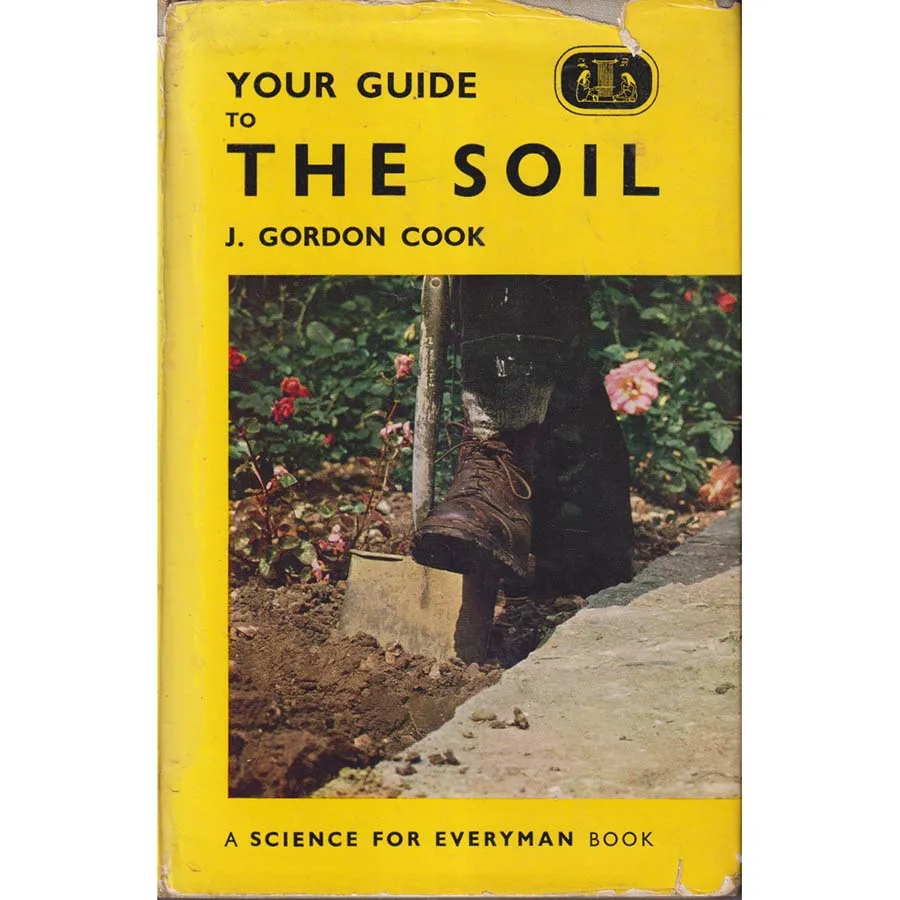
The cover rather wonderfully sets the tone: a boot, a spade and some freshly disturbed earth. No glamorous gardening fantasy here. Someone is going to have to dig.
Cook explains soil as a living and changing system rather than simply the substance plants are pushed into and expected to cope with.
Different soils behave differently.
Clay sticks together.
Sand lets everything drain through.
Loam is the one gardeners talk about approvingly.
Peat has opinions of its own.
And somewhere in the middle of all this are acidity, alkalinity, nutrients, humus, drainage and an entire underground population of worms and microorganisms performing unpaid maintenance.
For the gardener, understanding soil is rather important.
Plants may look as though they are concerned mainly with sunlight and flowers, but most of the serious business is happening below ground.
A plant in the wrong soil can sulk magnificently.
A plant in the right soil can suddenly grow with such enthusiasm that you begin to suspect it is planning something.
Published in 1965, the book comes from an era when popular science books still assumed that ordinary readers might actually enjoy understanding how the natural world worked.
Hence the splendid subtitle on the cover: A Science for Everyman Book.
No specialist degree required.
Just curiosity, a willingness to learn and preferably access to somewhere muddy.
There is something particularly appealing about mid-century practical science books like this.
They do not merely tell you what to do.
They explain why.
Why does soil become waterlogged?
Why do some plants dislike lime?
Why is organic matter useful?
Why does one patch of garden behave perfectly while another seems capable of killing anything more ambitious than a dandelion?
These are serious questions.
Especially after you have spent money on shrubs.
The book should appeal not only to gardeners but also to anyone interested in natural history, agriculture, environmental science or the wonderfully complicated relationship between plants and the ground beneath them.
It is also a nice reminder that soil itself is not simply inert dirt.
It is an ecosystem.
A very untidy ecosystem, admittedly, but an ecosystem nevertheless.
This copy is in Good condition, and the original illustrated dust jacket gives it plenty of pleasing 1960s character.
The jacket shows some normal age and edge wear, which seems entirely appropriate for a book devoted to a subject routinely attacked with forks, spades and heavy boots.
At around sixty years old, it has survived far better than most bags of compost.
Ideal for vintage gardening enthusiasts, practical-science collectors, agricultural-history readers or anyone who has ever looked at a disappointing flowerbed and decided the soil must somehow be responsible.
Sold by Crappy Old Books, where we respect the importance of good soil, good drainage and keeping actual mud a safe distance from the book stock.
ISBN: None
Condition: Good
Keep browsing: See more Gardening books Other books by J Gordon Cook
